


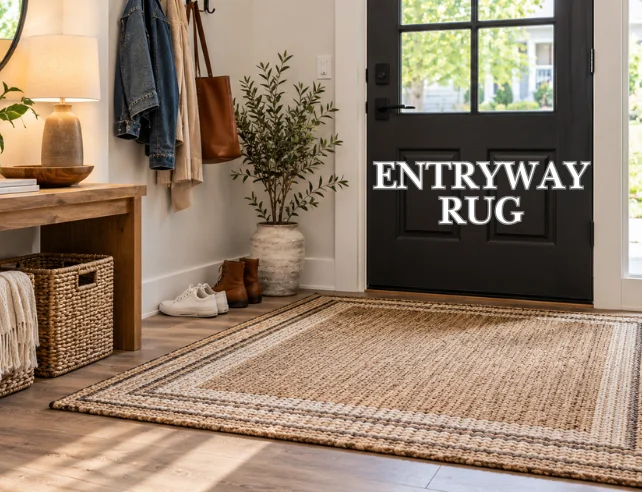
An entryway rug should protect your floor, work with the front door, and make the entrance feel connected to the rest of your home. The right choice depends more on your available floor space and daily traffic than on a fixed decorating rule. Start with measurements, favor easy-care materials, and keep the pile low enough for comfortable door clearance.
| Entry Rug layout | Common starting size | Shape to consider | Main priority |
|---|---|---|---|
| Compact doorway | 2′ x 3′ | Rectangle | Door clearance |
| Small foyer | 3′ x 5′ or 4′ x 6′ | Rectangle | Balanced coverage |
| Long, narrow entrance | 2′ x 6′ to 2.5′ x 10′ | Runner | Clear walking path |
| Larger foyer | 5′ x 7′, 5′ x 8′, or 6′ x 9′ | Rectangle or round | Scale and furniture |
| Mudroom-style entrance | Varies by usable floor | Runner or rectangle | Washability |
Quick answer: For most U.S. homes, choose a low-pile, easy-clean floor covering sized to the entrance layout, then check the full door swing before buying. A 2′ x 3′ works near compact doors, a 3′ x 5′ suits many small foyers, and a runner fits long, narrow entrances.
Key Takeaways
| Decision | Practical rule |
|---|---|
| Size | Measure usable floor instead of relying on one universal border rule. |
| Thickness | Check the complete door swing before choosing pile height. |
| Material | Match cleanability to dirt, rain, snow, pets, and household traffic. |
| Placement | Keep the main walking route clear and prevent unwanted movement. |
| Style | Coordinate with nearby rooms without making every textile match |
How to Choose an Entryway Rug That Works in Real Life
Start with function before color or pattern. Your entrance is exposed to outdoor grit, damp shoes, packages, pet traffic, and repeated footsteps throughout the day. A beautiful floor covering that blocks the door or becomes difficult to clean can quickly turn into an inconvenient purchase. Your decorating choices can come after those practical checks.
Home Votel’s simple tips for improving your home’s aesthetic recommend using the entrance to create a welcoming first impression through coordinated furnishings, lighting, and decorative details. Treat the floor covering as part of that larger arrangement rather than as an isolated accent.
Entryway Rug Size: Measure the Door and Walking Path First
Current sizing guides agree on common dimensions but differ on how much bare flooring should remain visible. Rugs Direct suggests roughly 12 to 24 inches where the layout permits, while Rugs USA recommends about 4 to 6 inches beside hallway runners. Those differences show why your actual room dimensions matter more than a single universal formula.
Use this four-step measurement method before shopping:
- Measure the usable width and length of the entrance, excluding furniture that narrows the walking area.
- Open the front door fully and mark its complete swing across the floor.
- Measure the clearance between the bottom of the door and the finished floor.
- Outline possible sizes with painter’s tape and walk through the entrance several times.
The tape test is especially useful in small American apartments and narrow foyers. It lets you see whether a 3′ x 5′ size feels balanced before you commit. It also shows whether guests can step inside, close the door, and move toward the next room without catching an edge.
Compare Practical Materials for a Busy Entrance
Material should reflect the conditions your household brings through the door. A home in a dry climate may place more emphasis on dust and grit, while snowy or rainy regions need easier moisture cleanup. Families with children or pets may also prefer a construction that tolerates more frequent cleaning.
| Material or construction | Strengths | Trade-offs | Good fit |
|---|---|---|---|
| Washable synthetic | Easy routine care, many patterns, often low profile | Check washer capacity and care label | Pets, children, wet-weather traffic |
| Polypropylene or performance synthetic | Stain-friendly, practical for frequent traffic | Feel varies by construction. | Busy everyday entrances |
| Low-pile wool | Comfortable, durable, polished appearance | Usually costs more and may need specialized care | Formal or larger foyers |
| Cotton blend | Soft and often washable | May absorb moisture quickly | Lighter indoor traffic |
| Flatweave | Thin profile and easy door clearance | Less cushioning underfoot | Tight door clearances and runners |
| Natural-fiber styles | Strong texture and casual appearance | Some fibers dislike frequent moisture | Drier interior entrances |
For many households, a washable synthetic or tightly constructed flatweave is the simplest starting point. Wool can make sense when appearance and long-term use matter more than machine washing. Current entry guides consistently emphasize low-profile construction, easy maintenance, and materials suited to heavy traffic.
Door Clearance Matters More Than a Trendy Thick Pile
An inward-swinging front door can turn a thick floor covering into a daily nuisance. Check the lowest point under the door because reinforced edges and a separate pad can increase the finished height. Low-pile and flatwoven options give you more room when clearance is tight. Don’t assume scraping means the textile itself is the only problem.
A sagging or swollen door can reduce clearance that previously worked without trouble. Home Votel’s guide on fixing a front door that rubs against the floor explains several door-related causes worth checking before replacing a floor covering that otherwise fits.
Match the Shape to the Architecture
A narrow hall generally looks more intentional with a runner that follows the direction of travel. A wider rectangular foyer can accommodate a 3′ x 5′, 4′ x 6′, or larger piece, depending on the usable dimensions. Square entrances may also suit round designs when the architecture and nearby furniture support that shape.
Color and pattern should connect the entrance with the rooms visible from it. You don’t need an exact match, but repeating a nearby neutral, wood tone, metal finish, or accent color can improve visual continuity. For broader flooring and decorating ideas, Home Votel’s article about small changes that refresh a home’s flooring and interior provides useful context.
Choose Colors That Can Handle Everyday Traffic
Pale solid colors can show shoe marks quickly in a busy front entrance. Mid-tone neutrals, mixed-color designs, and small repeating patterns tend to make routine dust less noticeable between cleanings. The goal isn’t to hide dirt indefinitely but to keep the space presentable during normal daily use. Consider the view from adjoining rooms before choosing a bold pattern.
A detailed design can add personality to a simple foyer, while a quieter piece may work better beside patterned wallpaper or bold flooring. This approach gives the entrance character without forcing every decorative element to compete for attention.
Plan for Rain, Snow, Pets, and Seasonal Dirt

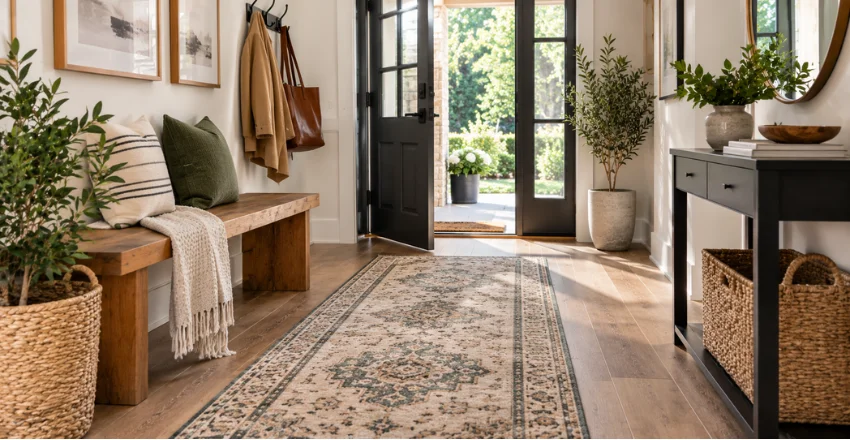
American households can ask completely different things from an entrance depending on the climate. Snow, road salt, rain, sand, muddy paws, and dry dust all affect how often the surface needs attention. A separate outdoor mat can remove heavier debris before shoes reach the interior floor covering.
Vacuum or shake out loose grit before it becomes embedded, then follow the manufacturer’s cleaning directions for deeper care. Machine-washable construction is convenient only when the product fits your washer, and its care instructions suit your routine. Let anything that becomes wet dry thoroughly before returning it to regular service.
Avoid the Most Common Buying Mistakes
Buying by appearance alone is the easiest mistake to make. A piece can have the perfect color but still be too thick, too small, difficult to maintain, or poorly positioned for the room. Measuring after you fall in love with a design reverses the order that produces the most reliable result. Another mistake is treating a decorative foyer covering like an outdoor doormat. Give each layer a clear job, especially in homes that see wet or dirty footwear.
If you’re improving more than the entrance, Home Votel’s home improvement section can help connect this small update with other practical projects around the house.
Make the Entrance Work Before You Decorate Around It
The strongest choice is the one that fits your real entrance, not the one that follows the most decorating rules. Measure the door swing and usable floor, choose a practical material, then narrow your options by color and pattern. That order gives you a welcoming entrance that can handle daily life without creating extra work.
Once the floor is settled, consider the lighting, storage, wall color, and surrounding furniture as a single connected area. Home Votel’s home improvement resources can help you integrate those updates into a broader plan rather than treating each change separately. A practical entrance should look good, but it should also make arriving home and leaving easier.
Frequently Asked Questions
What size entryway rug should I choose?
A 2′ x 3′ size works well as a compact landing near many single doors, while 3’ x 5’ and 4’ x 6’ sizes suit many small foyers. Long entrances often work better with runners around 2 feet wide. Measure the room and door swing first because published border recommendations vary considerably.
Should the floor covering be wider than the front door?
It can be wider, but door width alone shouldn’t determine the dimensions. The usable entrance width, traffic path, furniture, and door swing provide a clearer picture of the appropriate scale. Test the proposed footprint with painter’s tape before buying if the proportions are difficult to visualize.
Are washable styles good for an entrance?
Yes, washable construction can be useful in homes with pets, children, or frequent wet-weather traffic. Confirm the product’s care label and make sure the size will fit the washing equipment you plan to use. Low-profile washable options can also work well where door clearance is limited.
Do I need a nonslip pad underneath?
A separate pad can help reduce movement when a floor covering lacks effective grip. Choose a pad compatible with both the flooring and textile manufacturers, especially for finished hardwood or resilient flooring. Include the pad’s thickness when checking clearance beneath an inward-swinging door.