
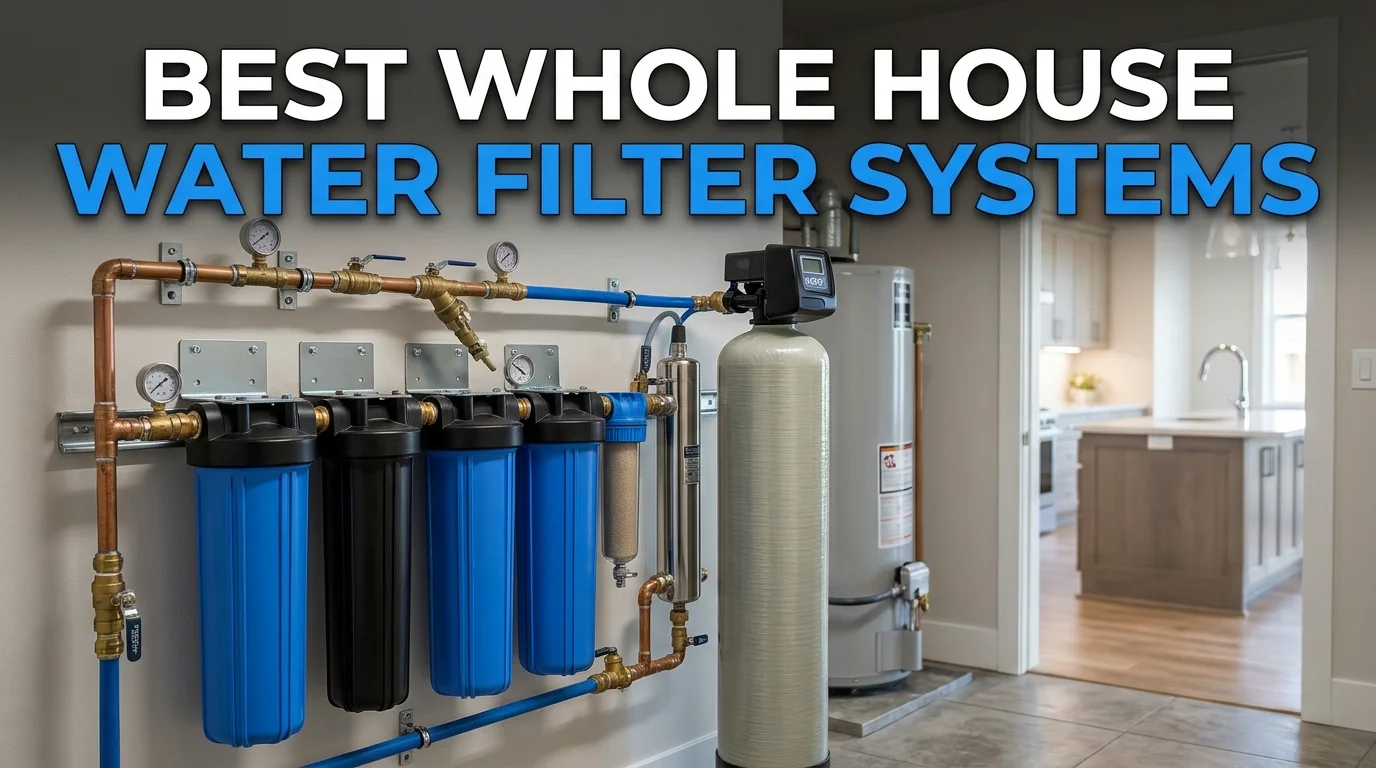
Choosing the best whole house water filter systems starts with your water, not a product ranking. City water, private wells, PFAS, chlorine, iron, and sediment require different treatment methods. The strongest choice matches verified contaminants while maintaining enough flow for your household.
Quick answer: SpringWell CF1 is our best all-around choice for many city-water homes because it combines high flow and long media life. Pentair FloPlus Protect stands out for certified PFAS reduction. Private-well owners should test first because iron, bacteria, sulfur, and hardness often need specialized treatment.
Whole-House Water Filters at a Glance
| System | Best for | Approx. flow | Capacity or service life | Key strength |
|---|---|---|---|---|
| SpringWell CF1 | Most city-water homes | 9 GPM | 1 million gallons | Long-life carbon system |
| Pentair FloPlus Protect 20BB | Certified PFAS reduction | 5 GPM | 40,000 gallons | NSF/ANSI 53 certification |
| Aquasana HealthShield | Broad contaminant reduction | About 5.7 GPM | 165,000 gallons | Certified PFAS and VOC reduction |
| iSpring WGB32B | Budget-conscious DIY buyers | Up to 15 GPM | About 100,000 gallons | Three-stage cartridge design |
| 3M Aqua-Pure AP904 | High household flow | 20 GPM | 100,000 gallons | Compact high-flow cartridge |
| Aquasana Rhino | Chlorine and long service life | 7 GPM | 1 million gallons | Long-life chlorine treatment |
| SpringWell WS | Well water with iron or sulfur | About 12 GPM | Long-life media | Air-injection well treatment |
Prices, replacement intervals, and performance can change with water conditions. Always check current manufacturer specifications before ordering. Flow requirements should also reflect simultaneous showers, faucets, and appliances.
How We Chose These Systems
We compared current specifications, contaminant claims, flow rates, filter life, and independent certifications. We gave extra weight to verified performance instead of broad marketing promises. Current U.S. rankings also show certification as a major dividing line between competing products.
We also considered how each design fits a realistic household problem. A chlorine filter should not win a well-water category simply because it has higher capacity. EPA guidance recommends identifying your treatment goals before choosing equipment.
1. SpringWell CF1, Best Overall for City Water
The SpringWell CF1 is a strong fit for households primarily concerned about chlorine, chloramine, taste, and odor. Its manufacturer rates the CF1 at 9 GPM for homes with one to three bathrooms. The media is rated for one million gallons or about ten years.
The design uses catalytic carbon, KDF media, and sediment filtration. Larger versions increase service flow to 12 or 20 GPM. SpringWell also provides a lifetime warranty on many covered system components.
Pros.
* Strong flow options for different home sizes. * Long-rated media life. * No regular tank regeneration. * Six-to-nine-month sediment prefilter interval.
Cons.
* Broad contaminant claims are not equivalent to certified reduction claims. * Professional plumbing may still be advisable. * It does not soften hard water.
Verdict: This is our strongest general-purpose pick for treated municipal water. Buyers concerned about specific health contaminants should verify certification before relying on any reduction claim.
2. Pentair FloPlus Protect 20BB, Best for Certified PFAS Reduction
Pentair’s FloPlus Protect 20BB deserves attention when PFAS is the main concern. The system is certified to NSF/ANSI 53 for five PFAS compounds. Pentair rates it for 5 GPM and a 40,000-gallon capacity.
Its relatively low flow is the major compromise. Five gallons per minute may suit smaller homes better than busy multi-bathroom households. The cartridge is rated for about twelve months, depending on usage and incoming water quality.
Pros.
* Independent NSF/ANSI 53 certification. * Targets five PFAS compounds. * Compact cartridge-based design. * Straightforward cartridge replacement.
Cons.
* 5 GPM flow can be limiting. * Shorter service capacity than large carbon tanks. * Replacement cartridges add recurring cost.
Verdict: Choose this system when verified PFAS reduction matters more than maximum household flow.
3. Aquasana HealthShield, Best for Broad Certified Reduction
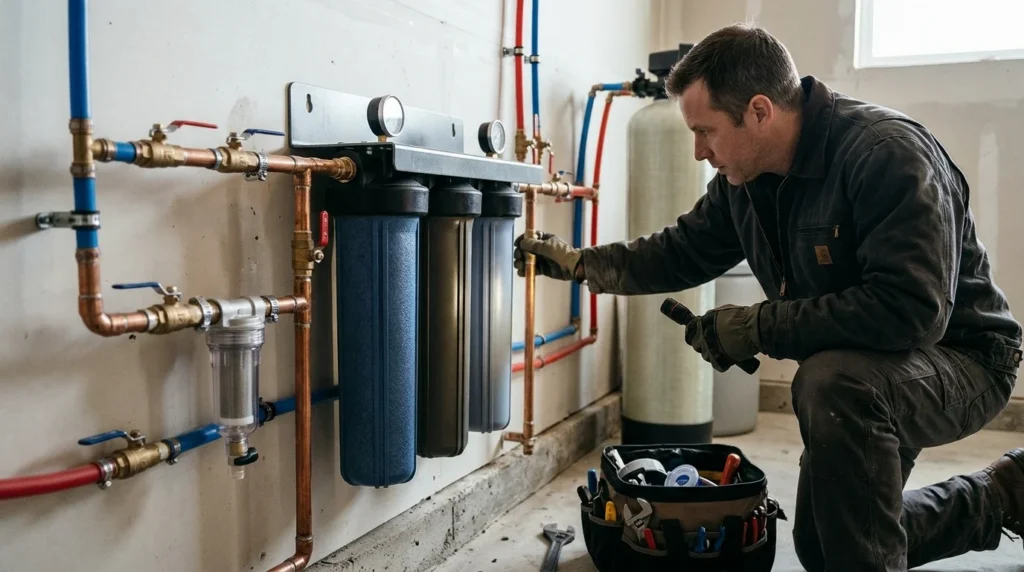
Aquasana HealthShield targets buyers who want broader contaminant reduction throughout their homes. Aquasana states the system reduces PFAS, VOCs, pharmaceuticals, chlorine, and chloramines. Current certification-focused comparisons also identify it as a leading certified option.
The trade-off is cost and replacement frequency compared with long-life carbon tanks. Its rated capacity is much lower than one-million-gallon systems. Buyers should compare replacement expenses before focusing on the initial purchase price.
Pros.
* Independent certification for important reduction claims. * Broad contaminant coverage. * Whole-home treatment. * Optional UV equipment for certain well-water applications.
Cons.
* Higher ownership cost. * Lower flow than several competitors. * Replacement intervals are shorter than long-life tank systems.
Verdict: HealthShield makes sense for households prioritizing certified contaminant reduction over low long-term maintenance costs.
4. iSpring WGB32B, Best Budget Three-Stage System
The iSpring WGB32B uses three large cartridge stages for sediment and carbon filtration. Its manufacturer lists flow up to 15 GPM and pricing near \$517 during our research. The system uses one-inch inlet and outlet connections.
iSpring’s comparison information lists around 100,000 gallons of filtration capacity for the WGB32B. Cartridge systems need more frequent maintenance than large tank-based media systems. They can still appeal to homeowners who value accessible replacement parts.
Pros.
* Lower purchase price than many tank systems. * Up to 15 GPM flow. * Three-stage filtration. * DIY-friendly documentation.
Cons.
* More frequent cartridge changes. * Performance claims vary by cartridge configuration. * Standard WGB32B is not the right choice for every heavy-metal problem.
Verdict: This is a practical value choice for sediment, chlorine, taste, and odor concerns on suitable water.
5. 3M Aqua-Pure AP904, Best High-Flow Cartridge System
The 3M Aqua-Pure AP904 is notable for its 20 GPM rated flow. That makes it attractive for larger households with simultaneous water demand. The system uses a compact single-cartridge configuration rather than several large tanks.
The AP904 targets sediment, chlorine taste, odor, and scale-related concerns. Its older technical documentation lists a 100,000-gallon capacity for the cartridge family. Manufacturer laboratory testing supports several performance claims, so buyers should distinguish those from independent contaminant certifications.
Pros.
* 20 GPM rated flow. * Compact design. * Sanitary cartridge replacement. * Suitable for larger peak-flow demands.
Cons.
* Not designed for every health-related contaminant. * Replacement cartridge cost matters. * Certification scope should be checked for your target contaminant.
Verdict: Consider the AP904 when preserving household flow is more important than broad contaminant removal.
6. Aquasana Rhino, Best Long-Life Chlorine System
Aquasana’s Rhino focuses on chlorine reduction for municipal water. The company rates it for one million gallons or up to ten years. Its standard version provides about 7 GPM of flow.
Aquasana states that Rhino and Rhino Max Flow have relevant WQA certifications for specific standards. The Max Flow version increases flow to 14 GPM. That option may suit larger households better than the standard model.
Pros.
* Long-rated filter life. * Standard and higher-flow versions. * Strong focus on chlorine reduction. * Established whole-home platform.
Cons.
* Standard 7 GPM flow may restrict busy homes. * Not every contaminant claim applies to every Rhino version. * Optional upgrades raise the total cost.
Verdict: Rhino suits homeowners primarily targeting chlorine without frequent main-tank replacement.
7. SpringWell WS, Best for Iron and Sulfur in Well Water
Private wells require a different buying approach than city water. SpringWell’s well systems target contaminants such as iron, hydrogen sulfide, sediment, and manganese. The company currently lists its whole-house well system starting above \$2,200.
Never select a well system from odor or staining alone. CDC recommends testing private wells at least annually for coliform bacteria, nitrates, dissolved solids, and pH. Local conditions may require additional testing for arsenic, lead, pesticides, or other contaminants.
Pros.
* Designed around common private-well problems. * Air-injection treatment options. * Automatic backwashing design. * Can be combined with other treatment stages.
Cons.
* Costs more than basic city-water filters. * Water testing is essential before selection. * Bacteria may require separate UV treatment.
Verdict: This category is a strong starting point for tested iron or sulfur problems, but laboratory results should determine the configuration.
Best Whole House Water Filter Systems by Water Problem
The best whole house water filter systems should solve a measured problem instead of treating every possible contaminant. Begin with your utility report or laboratory test. Then match the treatment technology to what the results show.
| Water problem | Treatment to investigate | Why it matters |
|---|---|---|
| Chlorine taste or odor | Activated or catalytic carbon | Improves taste and reduces chlorine |
| Chloramine | Catalytic carbon designed for chloramine | Standard carbon may be less effective |
| PFAS | Certified NSF/ANSI 53 system | Certification confirms specific reduction |
| Sediment or rust | Sediment cartridge or prefilter | Protects later filtration stages |
| Iron or sulfur | Oxidation plus filtration | Targets staining and rotten-egg odors |
| Hard water | Water softener or conditioner | Filtration alone does not remove hardness |
| Bacteria in well water | Appropriate disinfection, often UV | Carbon alone does not disinfect water |
Hardness deserves special attention because filtration and softening are different jobs. EPA guidance recommends certified softening equipment when excessive hardness is the problem. Some locations also restrict certain salt-based softeners.
How Much Flow Rate Does Your Home Need?
Flow rate determines how many fixtures can operate comfortably at once. A filter that performs well in a laboratory can still frustrate you if household pressure drops. Larger families and multi-bathroom homes usually need more peak flow.
Compare the filter’s rated service flow with your household’s expected simultaneous demand. A 5 GPM certified system may suit a smaller home but constrain several running fixtures. Systems offering 12 to 20 GPM provide more headroom for busy households.
Existing plumbing can also affect pressure and water quality. Corrosion, mineral buildup, or aging pipes may create problems a filter cannot solve. HomeVotel’s guide to replacing old pipes explains warning signs worth checking first.
Should You Test Your Water Before Buying?
Testing is one of the smartest steps before spending thousands of dollars. Public-water customers can start with their utility’s Consumer Confidence Report. EPA says these reports provide state-certified laboratory results for regulated drinking-water contaminants.
Private-well owners carry more responsibility because federal public-water regulations do not cover private wells. CDC recommends annual testing and additional local testing when conditions warrant it. No single treatment technology protects against every possible well-water problem.
A test can also prevent unnecessary equipment purchases. Hardness, bacteria, PFAS, iron, chlorine, and lead require different responses. Spending on an oversized system before testing can increase purchase and maintenance costs.
Installation and Maintenance Costs to Consider
Equipment price is only part of the ownership cost. Professional installation may require new valves, bypass plumbing, drain connections, or electrical work. Replacement cartridges and sediment filters should also enter your comparison.
Large media tanks often reduce routine cartridge spending but cost more initially. Cartridge systems may cost less upfront while requiring annual replacements. Certified specialty filters can carry higher replacement costs because their media targets specific contaminants.
Plan for leaks and plumbing access during installation. HomeVotel’s guide to preventing water damage explains why shutoff valves and plumbing inspections matter. You can also browse its home improvement resources when planning related upgrades.
What to Look for Before You Buy
Start by identifying the contaminant you need to reduce. Then look for independent certification covering that specific claim. A certification for chlorine does not automatically certify PFAS, lead, or bacteria reduction.
Next, compare service flow, capacity, replacement costs, and available installation space. Check whether the system needs drainage, electricity, or professional servicing. Read the performance data sheet instead of relying only on marketing summaries.
Finally, calculate several years of ownership instead of comparing purchase prices alone. A cheaper housing can become expensive with frequent cartridge changes. A higher-priced tank can cost less annually when its media lasts many years.
Our Final Recommendation
For many U.S. homes using municipal water, SpringWell CF1 offers the strongest balance of flow and long media life. Pentair FloPlus Protect is more compelling when certified PFAS reduction is the priority. Aquasana HealthShield deserves consideration when broader certified reduction matters most.
Well-water households should not select equipment from a generic ranking alone. Test the water and build treatment around the results. That approach is safer, more efficient, and less likely to waste money.
Frequently Asked Questions
What are the best whole house water filter systems for most homes?
There is no universal winner because household water problems differ. SpringWell CF1 is a strong city-water option, while Pentair FloPlus Protect targets certified PFAS reduction. Well owners should choose treatment only after testing their water.
Is a whole-house water filter worth it?
It can be worthwhile when contaminants affect water throughout the home. Whole-home treatment can address shower, laundry, appliance, and drinking-water concerns together. EPA notes that point-of-entry systems treat water before distribution through the building.
Does a whole-home filter remove hard water?
Most standard carbon filters do not remove hardness minerals. Hard water usually requires a softener or specialized scale-control system. Check certification and local rules before buying salt-based equipment.
Can a whole-house filter remove bacteria from well water?
A standard sediment or carbon filter should not be assumed to disinfect water. Bacterial contamination may require UV or another validated disinfection method. CDC recommends confirming treatment success with testing.
How often do whole-house filters need replacement?
Replacement schedules vary widely by technology and incoming water quality. Cartridge systems may need annual service, while large media tanks can last several years. Follow the manufacturer’s specifications and monitor changes in pressure or water quality.
Is NSF certification important?
Certification is especially useful when you need verified reduction of a specific contaminant. Check the exact standard and listed reduction claim rather than looking only for an NSF logo. Different certifications cover different performance categories.